
How is GGNomad different from Booking.com?
GGNomad provides an operator-first workspace for travel businesses to manage multi-vertical inventory and own customer relationships, whereas Booking.com operates as an…
About this answer — Produced by our own assistant on 24 September 2026 from our published documentation. The pages it drew on are linked under the answer. It is generated text, not a statement from a person — where it and a linked page disagree, the page is right.
Answer
GGNomad[1] provides an operator-first workspace for travel businesses to manage multi-vertical inventory and own customer relationships, whereas Booking.com operates as an accommodation-first online travel agency (OTA).
| Platform | Inventory scope | Traveler relationship | Commercial model |
|---|---|---|---|
| GGNomad[2] | Stays, tours, events, and daily itineraries | Operator owns the traveler relationship | Subscription plus sliding platform fee |
| Booking.com | Accommodation-focused with limited experiences | Booking.com owns the customer relationship | 10–25% commission per booking |
Key differences include:
- Connected inventory and itineraries: GGNomad models stays, tours, activities, and event tickets as connected first-class items scheduled by day with running totals, rather than standalone room bookings or basic wishlists.
- Dedicated operator workspace: Agencies, DMCs, and hotel groups manage their listings, bookings, and analytics in role-governed workspaces, illustrated in the GGNomad: Marketplace Command Centre[3].
- Lower take rates: Instead of high per-booking commissions, GGNomad pairs predictable subscriptions with a sliding platform fee.
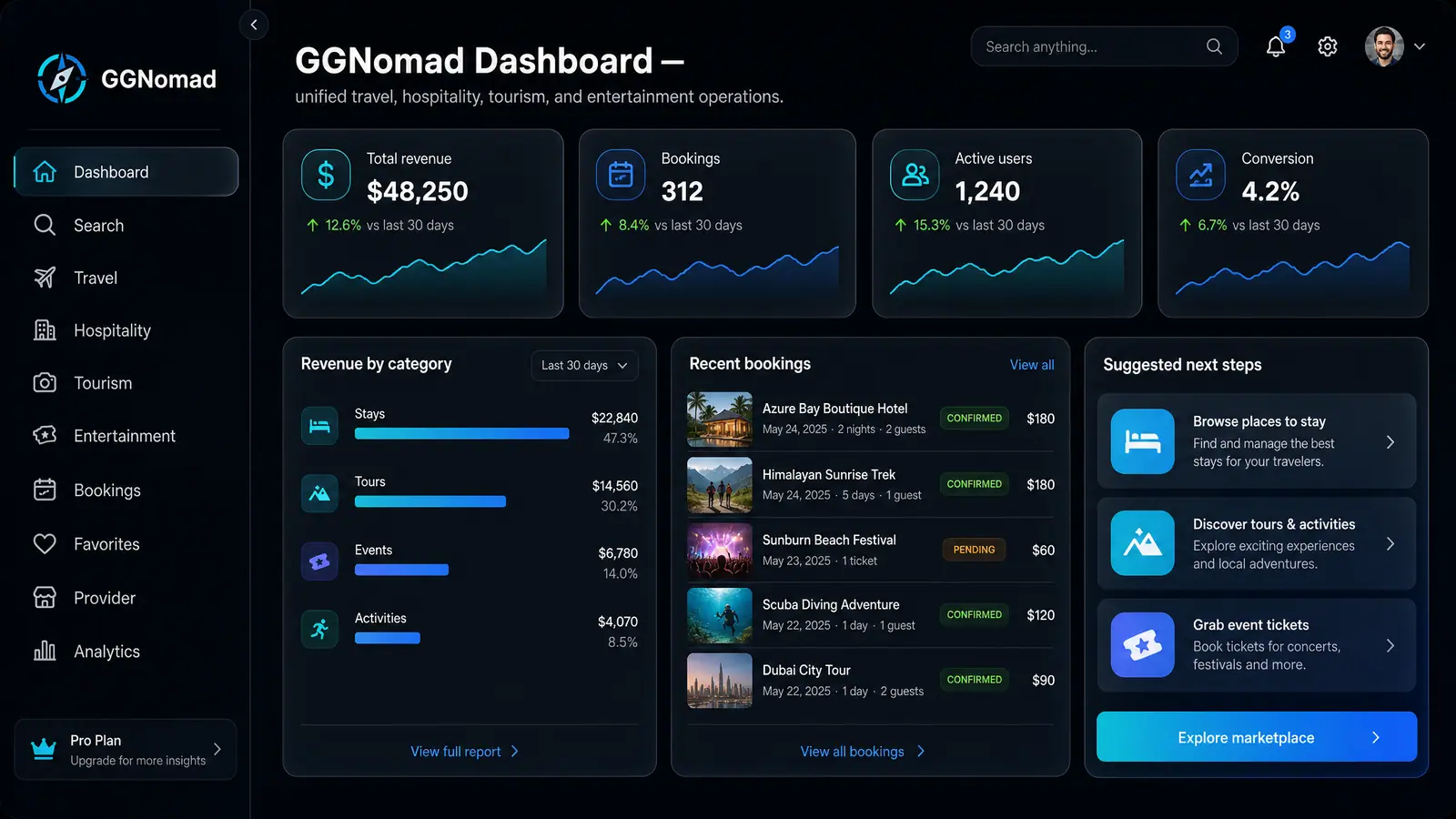 (opens in a new tab)
Illustration of the concept, not a screenshot of the actual product — Marketplace Command Centre[3]
To review the full breakdown, visit the GGNomad vs Booking.com comparison page[2].
Sources
The pages this answer was drawn from.